13 Earthy Cozy Bedroom Ideas to Create a Warm and stylish look
There’s something deeply soothing about stepping into a bedroom that feels like the earth itself wrapped its arms around you. Earthy, cozy bedrooms have surged in popularity because they tap into our primal need for warmth, comfort, and connection to the natural world — a welcome antidote to the cold, clinical interiors that dominated design for so long. Think warm terracotta walls, chunky linen throws, raw wood headboards, and the gentle glow of candlelight bouncing off clay pots. These spaces don’t just look beautiful; they feel restorative in a way that sleek, minimalist rooms rarely do. Whether you’re starting from scratch or simply refreshing what you have, earthy bedroom design is surprisingly achievable on any budget. In this article, we explore 13 of the most inspiring earthy cozy bedroom ideas, each packed with texture, warmth, and organic detail that will transform your sleeping space into the ultimate sanctuary.
1. Terracotta Walls with Warm Linen Bedding
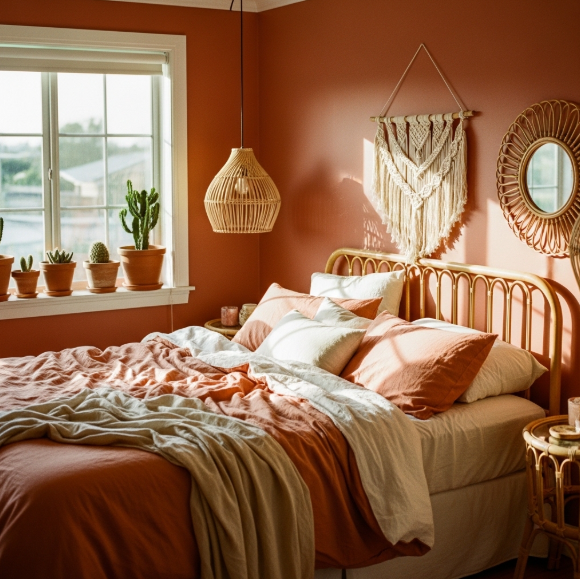
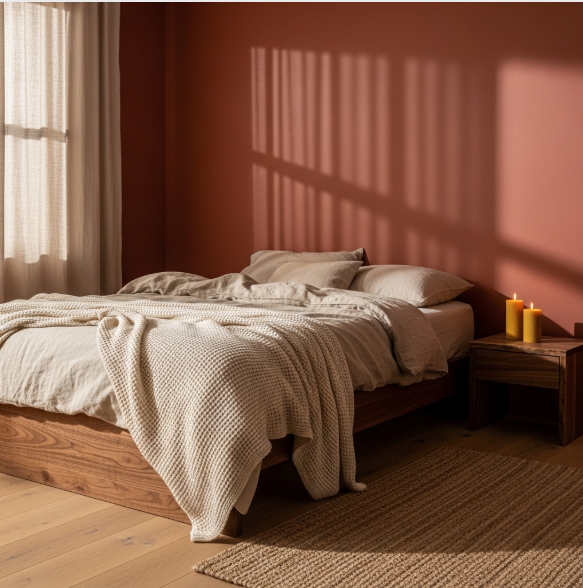
Few color choices are as instantly transformative as terracotta. This deep, sun-baked orange-red tone has an ancient, elemental quality — it evokes the Mediterranean hillsides, Moroccan riads, and the dusty warmth of a late summer afternoon. Painting your bedroom walls in a true terracotta or a muted clay variant immediately raises the warmth of the room by several visual degrees. The key to making it work is pairing it with the right bedding: raw, undyed linen in oatmeal, cream, or warm sand creates the perfect contrast, soft and breathable against the boldness of the walls. Layer a chunky cotton waffle blanket at the foot of the bed, add pillowcases in muted rust and dusty rose, and let the earthy palette do the work. This combination photographs beautifully in natural light and feels incredibly intimate at night when lit by warm-temperature bulbs or beeswax candles on the nightstand. The finish of the paint matters too — a matte or limewash finish absorbs light rather than reflecting it, giving the walls an organic, almost ancient texture. Terracotta works best when the rest of the room echoes its warmth through natural wood tones, woven baskets, and clay accessories rather than fighting it with cool metals or stark white.
2. Raw Wood Headboard as a Focal Point
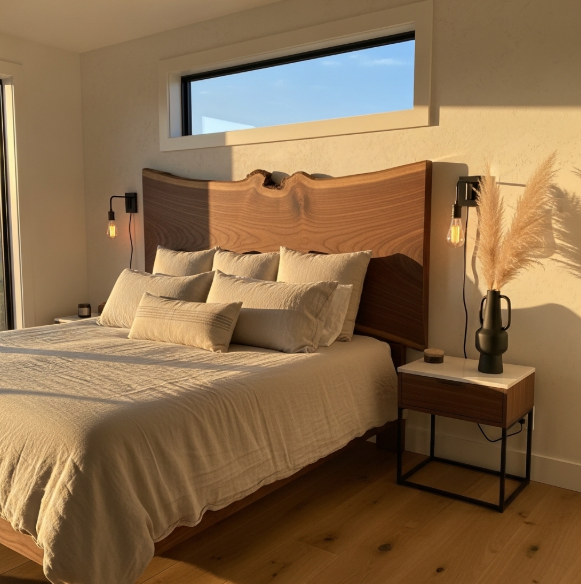
Wood is one of the most powerful tools in earthy interior design, and the headboard is the single most impactful piece of furniture in a bedroom. A raw or live-edge wood headboard instantly roots the room in nature, becoming a focal point that no amount of art or wallpaper could quite replicate. The beauty of live-edge wood lies in its imperfection — the natural curves of the tree’s original form are preserved, making every piece completely unique. Whether you choose a pale ash, a warm walnut, a reclaimed oak with visible saw marks, or a dark smoked pine, the grain and texture of raw wood reads as genuinely organic against soft bedding. Style the headboard simply: a few dried pampas grass stems in a ceramic vase on one side, a stack of worn hardback books on the other, and a single textile wall hanging above if the headboard is lower. Avoid cluttering the space around it — raw wood commands attention and deserves room to breathe. If a full live-edge slab is beyond budget, consider a reclaimed wood plank headboard, a DIY shiplap panel painted in warm white, or even a beautiful piece of driftwood mounted horizontally for a coastal-earthy hybrid look.
3. Limewash Paint for Textured Walls
If you want the warmth of earthy walls without committing to a strong color, limewash paint is your greatest ally. Unlike standard emulsion, limewash produces a beautifully mottled, layered finish that mimics the appearance of old European plaster walls — the kind you find in centuries-old farmhouses in Tuscany or Provence. The technique involves applying thinned, lime-based paint in multiple coats, each slightly translucent, creating depth and movement on the surface that shifts subtly depending on the light and time of day. In the morning, a limewash wall in warm white or pale sage reads almost luminous; at dusk, it turns richly shadowed and cave-like. This tactile quality is central to earthy bedroom design — it makes the walls feel alive rather than flat. Limewash works beautifully behind a bed as a statement wall, especially when paired with natural fibre rugs, beeswax or soy candles, and unbleached cotton or linen bedding. Modern brands like Portola Paints and Bauwerk have made limewash increasingly accessible, with pre-mixed formulas that can be applied over standard drywall by non-professionals. The result is a bedroom that looks genuinely ancient and deeply considered.
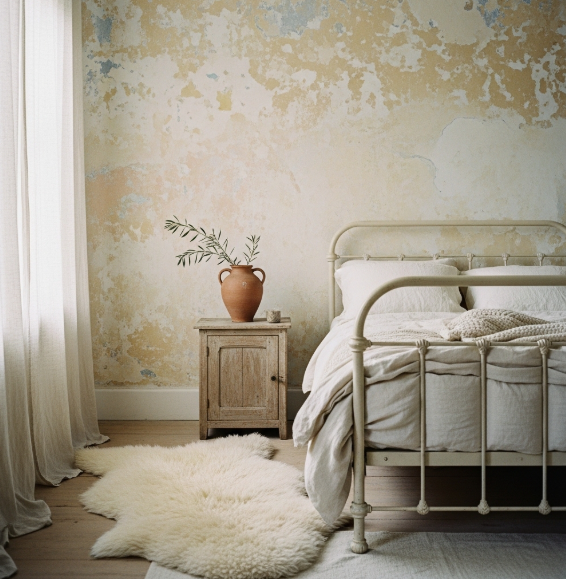
4. Woven Textile Wall Hangings
Walls in earthy bedrooms shouldn’t be bare, but they also shouldn’t be covered in framed prints or gallery walls that feel too urban and curated. Woven textile wall hangings strike the perfect balance — they add visual interest and warmth without the hardness of frames or glass. Hand-woven macramé pieces, Moroccan Beni Ourain-inspired tapestries, Peruvian wool hangings, or simple loomed cotton pieces in neutral tones all carry a wonderful handmade quality that mass-produced art simply cannot replicate. The textures — loops, fringe, knotting, thick pile — catch light beautifully and add physical dimension to the wall. For an earthy palette, look for weavings in natural undyed wool, desert sand, terracotta, warm rust, forest green, and deep ochre. Sizing matters: a large, floor-grazing piece behind the bed can replace a headboard entirely in a more bohemian scheme, while smaller pieces grouped asymmetrically along a side wall create a collected, well-traveled feeling. Pair textile hangings with plants trailing from a high shelf nearby, and the organic quality of the room intensifies dramatically.
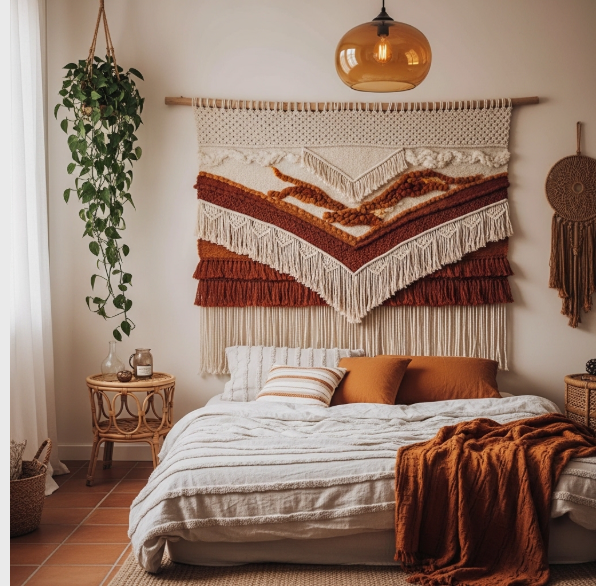
5. Mushroom and Mocha Tones Throughout
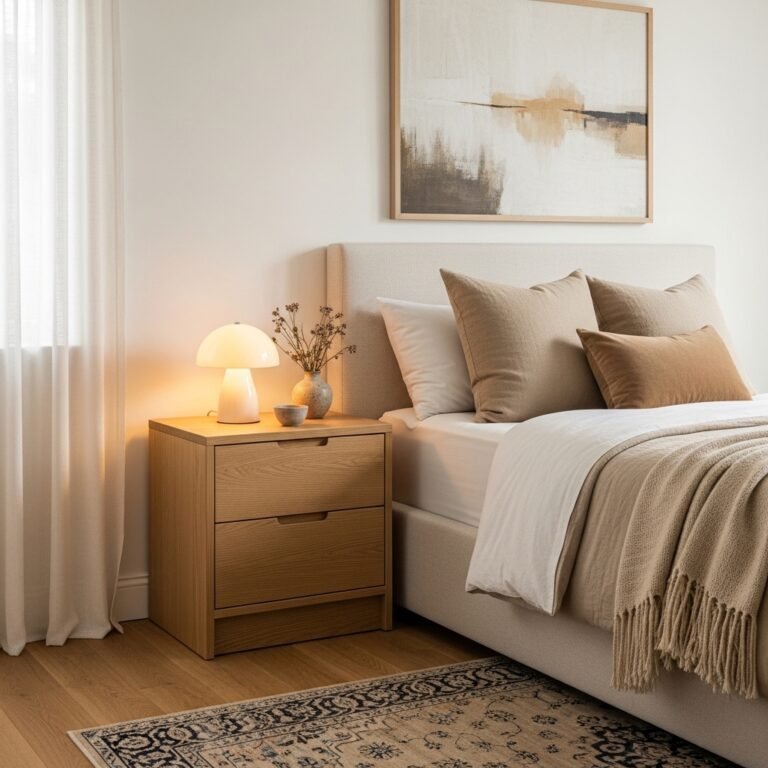
The so-called “mushroom palette” — those warm, greige, brown-beige tones that sit somewhere between taupe and chocolate — is one of the most sophisticated and livable color families in interior design. In a bedroom, a full mushroom and mocha scheme feels like being wrapped in cashmere: quietly luxurious, deeply restful, and completely unfussy. The secret is layering multiple tones from the same family rather than sticking to a single shade. A deep mocha headboard wall, mid-tone mushroom bedding, pale latte-colored curtains, and warm brown timber furniture creates a tonal composition that is rich without being heavy. Introduce contrast subtly — a single white ceramic lamp, cream knit throw, or pale ivory pillow — to stop the palette from feeling muddy. The materiality of mushroom tones matters just as much as the colors themselves: matte, tactile surfaces like brushed plaster, unbrushed velvet, and raw cotton reinforce the earthy quality. This palette is also exceptionally flattering in candlelight and warm artificial light, making it an ideal choice for a room intended for winding down and switching off from the world.
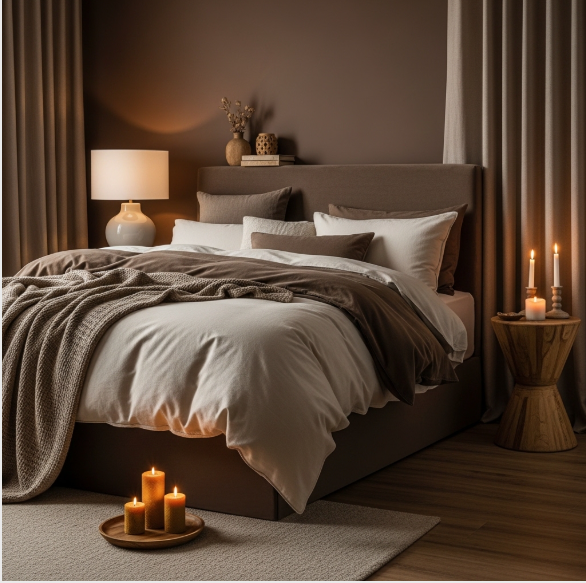
6. Rattan and Bamboo Furniture Accents
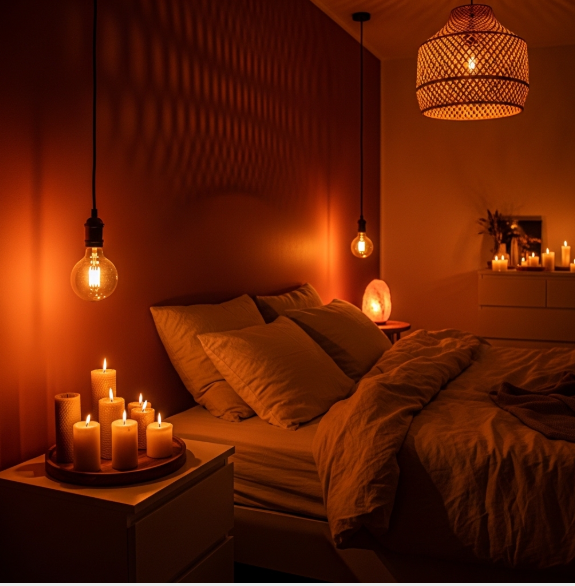
Few materials signal “earthy cozy bedroom” as immediately as rattan and bamboo. These natural fibres have a lightness and warmth that works across a wide range of styles — from relaxed coastal to full boho-maximalist to refined Japandi. A rattan pendant light hanging low over the bed casts warm, patterned shadows across the ceiling that instantly make a room feel more intimate. A bamboo or rattan bedside table with a woven surface adds organic texture at eye level without the visual weight of solid wood furniture. Even small rattan accessories — a tray, a mirror frame, a small chair — carry significant design impact. The woven open-weave quality of rattan is particularly valuable because it adds texture and pattern without solid mass, keeping the room feeling light and airy even when it’s layered with heavy linens and plush rugs. For a modern approach, combine rattan with matte black metal and dark wood for a more edited, sophisticated take; for a warmer, more romantic feel, pair it with cream plaster walls, dried flowers, and terracotta. The material ages beautifully, developing a slightly honey-amber patina over time that only enhances its character.
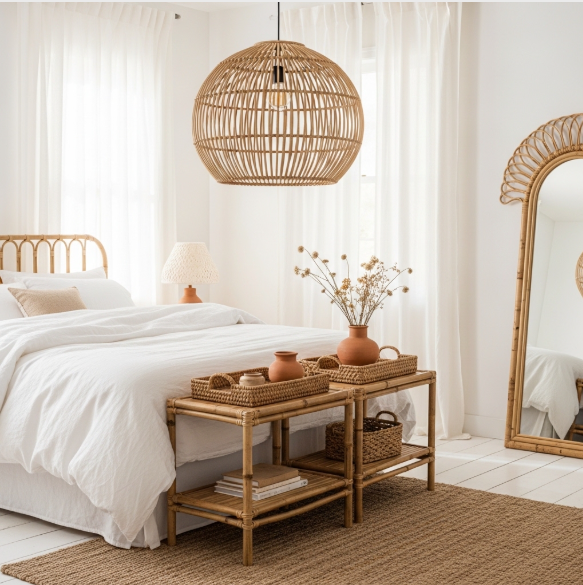
7. Forest Green Velvet for Depth and Richness
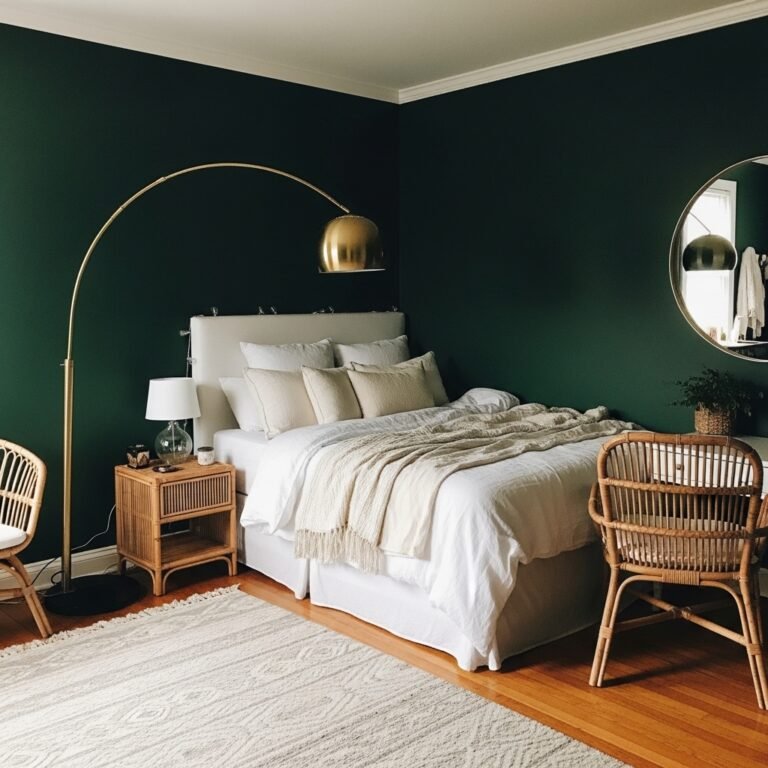
Earthy bedrooms don’t have to be all sand and stone. Deep forest green — the color of old moss, lichen-covered boulders, and ancient ferns — is one of nature’s most grounding and atmospheric tones, and in a bedroom it creates a sense of being cocooned inside a living, breathing landscape. Forest green velvet, in particular, has an extraordinary quality: the pile catches light differently from every angle, shifting from deep emerald in shadow to bright leaf-green in direct light. A forest green velvet headboard or upholstered bed frame is a stunning statement piece that pairs beautifully with warm wood tones, burnt orange accessories, aged brass hardware, and cream or ivory linen. The combination has an old-world richness — think English country house meets modern organic — that feels genuinely luxurious. Green doesn’t have to be limited to large furniture pieces, either: forest green cushion covers, a velvet throw draped over the corner of the bed, or even painted built-in wardrobes flanking the bed all work beautifully. The key is grounding the green with warm-toned naturals rather than cool greys or stark white, which can make it feel cold rather than earthy.
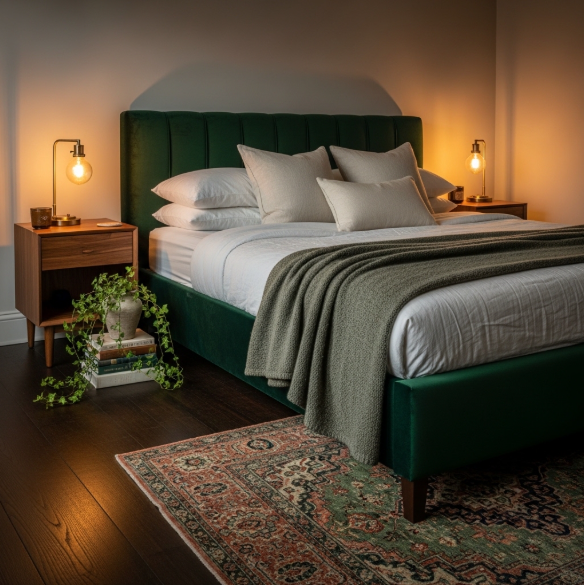
8. Layered Rugs for Warmth Underfoot
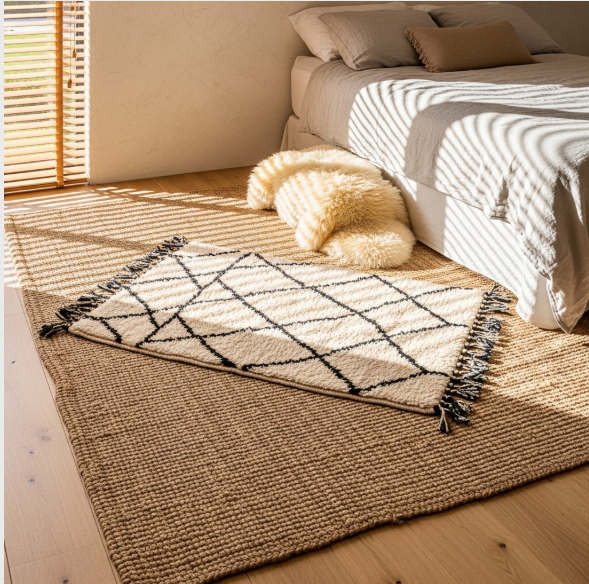
Few things make a bedroom feel more cozy and rooted than the simple act of layering rugs. A single rug beneath the bed is conventional and practical; two or three overlapping rugs in complementary textures and tones is earthy, eclectic, and endlessly warm. The base layer might be a large natural jute or sisal rug, whose slightly rough, honey-coloured weave immediately grounds the space in organic material. On top, a smaller Moroccan Beni Ourain in creamy white with geometric black symbols, or a hand-knotted Turkish kilim in earthy reds and oranges, adds pattern and personality. A third layer — perhaps just a small sheepskin or thick cotton bath mat beside the bed — creates a soft landing for bare feet first thing in the morning. The beauty of layering is that it removes the need for everything to perfectly match: a range of textures (flat weave, pile, shag, woven) and a palette drawn from the same earthy family creates cohesion naturally. Layered rugs also have an insulating effect, both thermally and acoustically, making the room feel genuinely quieter and warmer.
9. Dried Botanicals and Pressed Flower Displays
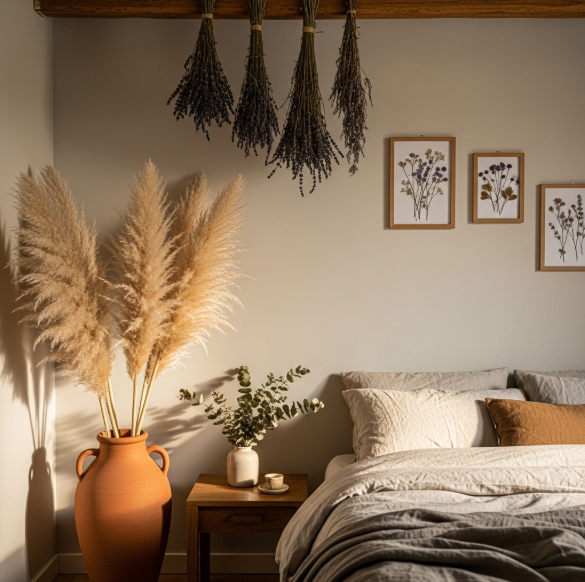
Fresh flowers are transient, but dried botanicals carry something even more special: the preserved beauty of nature at its peak, frozen in time. An earthy cozy bedroom benefits enormously from dried botanical arrangements — not just as accessories, but as a design philosophy that embraces the impermanent, organic, and wild. A large bunch of dried pampas grass in a tall terracotta pot beside a floor lamp creates a soft, feathery silhouette against the wall. A cluster of dried lavender hanging above the bed releases a faint, calming scent that supports sleep. A collection of pressed ferns and wildflowers framed in simple wooden or black frames adds nature-inspired art that costs almost nothing but has a genuine handmade quality. Dried olive branches in a ceramic vase, bundles of dried eucalyptus tied with jute twine, seed heads of alliums in a slim bud vase — all of these bring the outside in with a quiet permanence. The muted, dusty tones of dried botanicals — faded pinks, warm straw yellows, pale greens, silvery grey — are perfectly in tune with the earthy palette, reinforcing warmth and natural beauty without the maintenance demands of living plants.
10. Exposed Wooden Beams and Ceiling Details
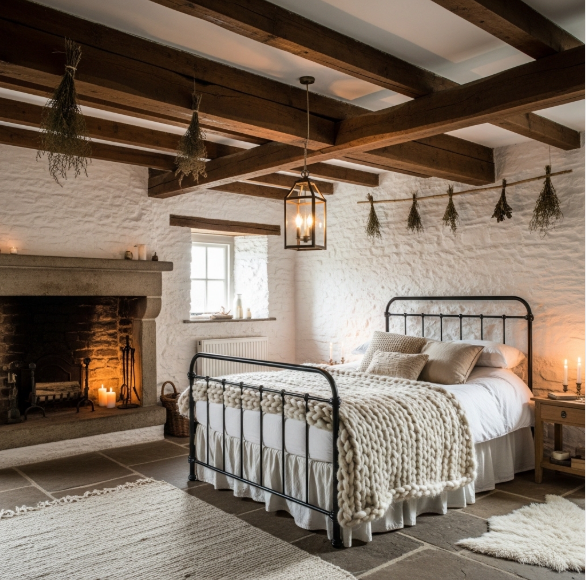
There are few architectural features as universally beloved in cozy bedroom design as exposed wooden ceiling beams. Whether original to the building or added decoratively, raw timber beams overhead immediately conjure images of Alpine chalets, farmhouse retreats, and centuries-old stone cottages — spaces that prioritise shelter, warmth, and character above all else. In a bedroom, beams draw the eye upward and frame the space, giving it a structured, purposeful quality while remaining entirely natural in material. The wood species and finish make a significant difference to the overall mood: pale, whitewashed beams feel Scandinavian and airy; dark, oiled oak feels more dramatic and Tudoresque; raw pine with visible knots reads as rustic and rural. Pair beams with a neutral palette below — white or off-white walls, natural linen bedding — to let the timber take centre stage, or embrace the drama by using deep earthy wall tones that make the beams recede into the warmth. Hanging pendant lights or a simple lantern from the beams adds to their functionality, and bundles of dried herbs or hops tied to the beams with twine is a lovely folk-inspired touch.
11. Candlelight and Warm Amber Lighting
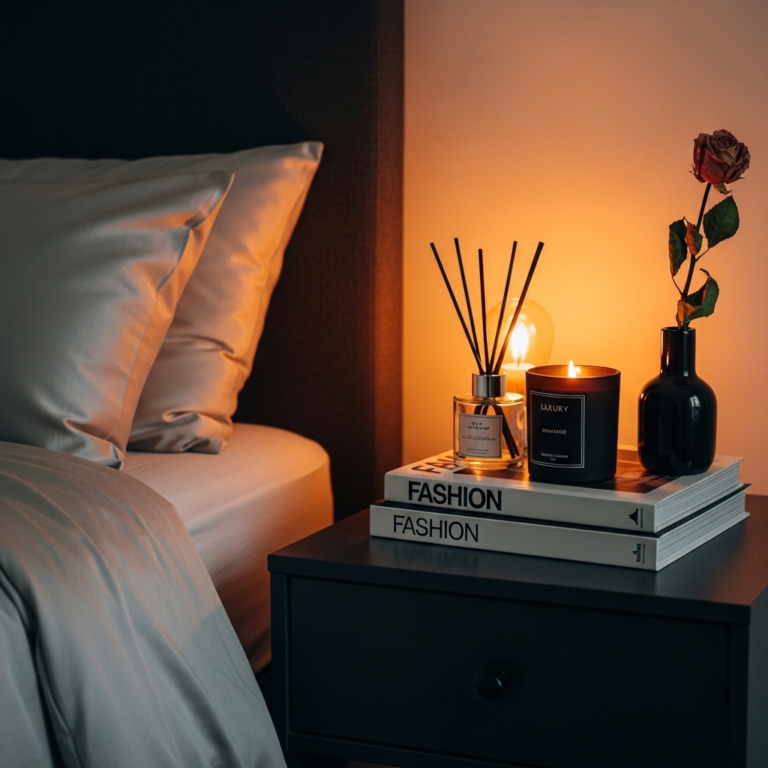
Lighting is arguably the single most transformative element in any interior, and nowhere is this more true than in the bedroom. The cool, bluish light of LED strips and overhead recessed lights is the enemy of cozy, earthy bedrooms — it signals wakefulness, flattens shadows, and strips warmth from every surface. The solution is to build a layered lighting scheme anchored by warm amber sources: beeswax or soy candles, Edison filament bulbs in warm white (below 2700K), salt lamp glow, and low-level table lamps with drum or fabric shades that diffuse light softly rather than projecting it harshly. The goal is to create light that behaves like natural firelight — warm, low, directional, with rich shadows. Candles in particular do something that no artificial light source can fully replicate: their gentle flicker and warm tone are biologically calming, signalling to the nervous system that it’s time to slow down. A cluster of beeswax pillars on a wooden tray beside the bed, a pair of terracotta candleholders on the windowsill, and a small salt lamp on the dresser creates a lighting environment that is profoundly restful. Invest in dimmable switches for all wall-mounted and table lamps, and commit to switching off overhead lighting after sundown.
12. Stone and Clay Accessories Throughout
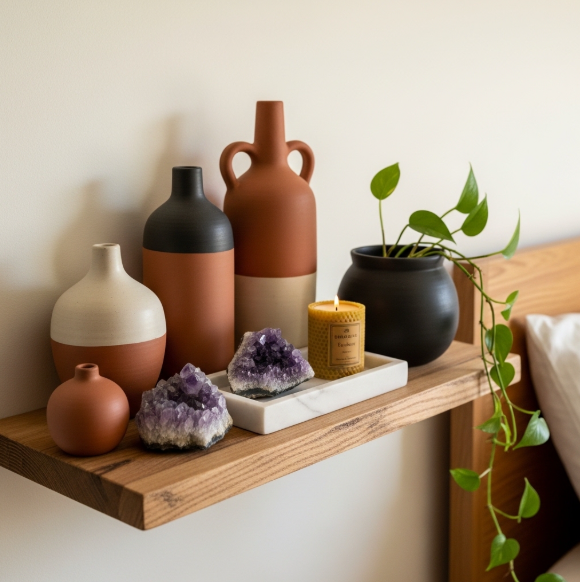
The accessories and objects you choose for an earthy bedroom are as important as the paint colours and furniture. Stone and clay — in the form of hand-thrown ceramic vessels, stone bookends, pebble collections, clay incense holders, and raw crystal clusters — bring a genuinely geological quality to the space, reminding you of the earth’s deep material richness every time you look at them. A hand-thrown ceramic mug for your morning herbal tea, a small rough-hewn marble tray for jewellery, a matte black clay pot holding a trailing plant, and a smooth river stone used as a paperweight all contribute to an environment that feels collected and intentional rather than styled for a photoshoot. The beauty of stone and clay is that they never go out of date and they improve with handling — clay develops a slight sheen where hands have touched it; stone reveals new patterns in different lights. Seek out items from small ceramicists and local potters where possible: the slight irregularity of handmade objects — the thumbprint in the clay, the uneven rim of a bowl — is precisely what makes them feel alive and earthy rather than mass-produced.
13. Cozy Reading Nook with Natural Textiles
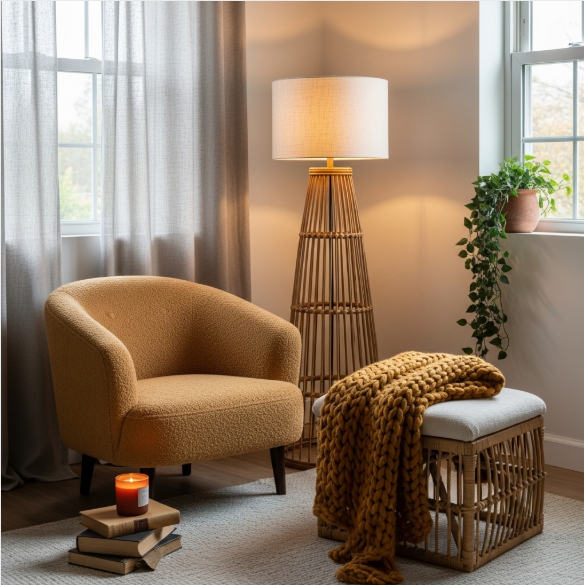
The ultimate expression of an earthy cozy bedroom is a dedicated reading nook — a small, purposefully designed corner that invites you to slow down, disappear into a book, and truly inhabit the space beyond just sleeping in it. In an earthy bedroom, a reading nook might mean a low, oversized linen floor cushion piled against the wall beneath a window, surrounded by stacked books and a single warm floor lamp with a linen shade. Or it could be a small armchair upholstered in boucle or natural-dye cotton tucked into a window bay, with a rattan footstool, a sheepskin draped over the back, and a tiny side table just large enough for a candle and a cup of tea. The key is abundance of natural textiles: chunky knit throws, layered cushions in earthy tones, a soft wool rug underfoot. Natural light should be maximised during the day — sheer curtains that filter rather than block, a low windowsill wide enough to sit on with cushions. In the evening, a single warm lamp positioned behind and above the chair at reading height creates the most human-scaled, inviting pool of light. This corner should feel like a retreat within a retreat.
Conclusion
Creating an earthy cozy bedroom isn’t about following a rigid set of rules — it’s about cultivating a feeling. The feeling of warmth when you walk through the door. The feeling of safety when you sink into the sheets. The feeling of groundedness that comes from surrounding yourself with materials that were once part of the living world: wood, clay, stone, wool, linen, dried botanicals. Whether you start by repainting one wall in terracotta, swapping your synthetic duvet for a raw linen one, or hunting down the perfect hand-thrown ceramic lamp for your bedside table, every step toward an earthier, cozier bedroom is a step toward a more restorative home. The 13 ideas in this guide can be mixed, matched, and adapted to any size room, any budget, and any existing style — the common thread is always nature, warmth, and the quiet beauty of imperfection. Your bedroom deserves to feel like the best kind of place on earth. Literally.